

A practical, evidence based guide to joint pain, muscle changes and tendon
symptoms around menopause – including exercise, strength training, HRT and when
to seek assessment.
Why can everything suddenly feel more achy in midlife?
Aching joints, stiff muscles and tendon pain are commonly reported during the menopausal
transition. For some women the change is striking: an Achilles tendon that suddenly dislikes
running, a shoulder that becomes painful and stiff, hip pain that interrupts sleep, or a general
sense that recovery from exercise is not what it used to be.
These symptoms are real, but menopause is not a diagnosis for every new ache.
Musculoskeletal pain is influenced by many things at once: hormonal change, age, sleep, stress,
physical activity, previous injury, strength, training load, body composition and specific conditions
such as osteoarthritis or tendinopathy.
The useful question is: What is contributing to this problem, and what can
we change?
Is musculoskeletal pain actually more common
around menopause?
Yes, although the exact figures vary between studies.
A systematic review and meta-analysis found musculoskeletal pain to be very common during the
menopausal transition and reported greater odds of pain in perimenopausal women than in
premenopausal women.
More recent research continues to explore the relationship between declining oestrogen and pain,
but association does not prove that oestrogen deficiency is the sole cause of an individual
woman’s symptoms.
Midlife also coincides with changes in sleep, work and caring demands, physical activity, body
composition and the prevalence of common musculoskeletal conditions.
Menopause may be part of the context without being the whole
explanation.
What does oestrogen have to do with muscles, tendons and joints?
Oestrogen receptors are found in musculoskeletal tissues, and oestrogen is involved in bone
metabolism, skeletal muscle biology, collagen turnover and aspects of pain processing.
The fall in circulating oestrogen across menopause is therefore biologically relevant.
But biology is not the same as destiny. We cannot look at one painful tendon or joint and conclude
that low oestrogen caused it. Human studies are affected by age, activity, previous injury,
metabolic health and many other factors.
A useful clinical model is that hormonal change may alter the environment in which muscles,
tendons, joints and the nervous system are adapting – while load, capacity and individual health
still matter.
What happens to muscle around menopause?
Muscle mass and strength tend to decline with age, and the menopausal transition may contribute
to changes in muscle composition and function.
That makes maintaining and building muscle increasingly important through midlife.
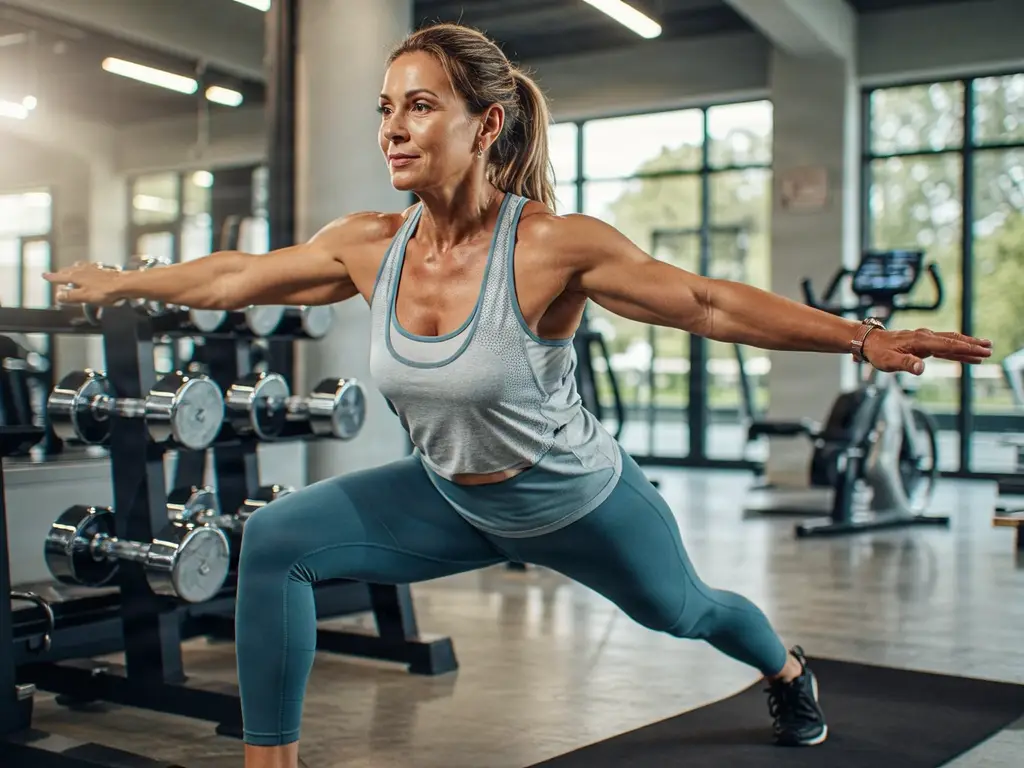
This is not an argument that every woman must become a powerlifter. It is an argument for giving
muscle a reason to adapt.
Progressive resistance training can improve strength and physical function, and it supports the
ability to keep doing ordinary things well: climbing stairs, carrying shopping, lifting children or
grandchildren, running, gardening and getting up from the floor.
The programme needs to be challenging enough to create adaptation, but the appropriate starting
load is individual.
Do women need to lift HEAVY in menopause?
The phrase ‘you must lift heavy in menopause’ has become popular online. It contains a useful
idea but can become unnecessarily rigid.
Progressive resistance training matters. As you become stronger, the resistance usually needs to
increase. But ‘heavy’ is relative to the person, the exercise and the goal.
Someone beginning strength training may make excellent progress with loads that an
experienced lifter considers light.
Research in postmenopausal women uses a wide range of resistance training programmes. A 2025
scoping review found that many studies broadly followed established strength training principles,
but there is no single menopause specific loading prescription that every woman must follow.
The target is progressive, appropriately challenging strength work that
you can recover from and continue.
What about bone health?
Bone deserves specific attention because the decline in oestrogen around menopause accelerates
bone loss.
Exercise cannot remove every osteoporosis risk factor, but mechanical loading is one of the
modifiable inputs that helps maintain bone health.
Recent systematic reviews and meta-analyses support resistance and impact based exercise for
bone mineral density in postmenopausal women.
A 2025 meta-analysis of 17 randomised trials involving 690 women found resistance training
improved bone mineral density at the lumbar spine, femoral neck and total hip. A 2026 systematic
review and meta-analysis has also examined high intensity, impact and strength training for bone
mineral density in premenopausal and postmenopausal women.
Walking is valuable for cardiovascular health, mood and general activity, but for bone and muscle
it should not necessarily be the only form of exercise. Resistance training and, where appropriate,
impact loading add a different stimulus.
Why do tendons seem to become troublesome?
Tendons respond to load. When the demand placed on a tendon exceeds its current capacity, pain
can develop.
Around midlife, hormonal changes may influence tendon biology, but the clinical picture is rarely
hormonal change alone.
A sudden increase in running, more hills, a new gym programme, reduced recovery, a period of
inactivity followed by rapid return, or changes in sleep and general health can all alter the balance
between load and capacity.
Common examples include Achilles tendinopathy, gluteal tendinopathy around the outside of the
hip, and rotator cuff related shoulder pain.
Tendons generally need appropriately dosed loading to regain capacity.
Does menopause cause frozen shoulder?
Frozen shoulder is more common in midlife and is seen more often in women, so it is
understandable that menopause is frequently blamed.
However, we do not currently have evidence that allows us to say menopause directly causes
frozen shoulder.
Frozen shoulder is also associated with diabetes and thyroid disease and can occur without an
obvious trigger.
If shoulder pain is accompanied by progressive restriction in both active and passive movement,
assessment can help distinguish frozen shoulder from rotator cuff pain, referred neck pain and
other causes.
A painful stiff shoulder should not be dismissed as ‘just hormones’. It deserves the same clinical
reasoning as any other musculoskeletal problem.
What about hip pain and GTPS?
Pain around the outside of the hip is common in midlife women and is often labelled trochanteric
bursitis.
In many cases the problem is better understood as greater trochanteric pain syndrome (GTPS),
frequently involving the gluteal tendons.
Hormonal factors may be relevant, but compressive positions, changes in walking or running load,
hip muscle capacity, sleep positions and other health factors can also contribute.
Progressive strengthening and sensible load modification are usually more useful than simply
avoiding activity. If side lying is painful, temporary sleep position changes can help while the
tendon is being rehabilitated.
Will HRT fix joint or muscle pain?
Hormone replacement therapy can be very effective for recognised menopausal symptoms and
has important effects on bone, but it should not be presented as a guaranteed treatment for
musculoskeletal pain.
A 2026 systematic review and meta-analysis examining hormone therapy and chronic
musculoskeletal pain found a complex and inconsistent evidence base across different pain
conditions. The authors noted that there is currently no clear guidance supporting HRT specifically
as a treatment for musculoskeletal pain.
If you are considering HRT, the decision should be based on your overall menopausal symptoms,
health history, benefits, risks and preferences with an appropriately qualified prescriber.
A painful Achilles tendon or shoulder may still need its own diagnosis and rehabilitation plan.
What type of exercise is best?
There is no single perfect menopause workout. A useful programme usually combines several
qualities rather than trying to make one exercise do everything.
Resistance training builds strength and muscle capacity.
Weight bearing and appropriate impact activity can support bone.
Aerobic exercise supports cardiovascular and metabolic health.
Balance and power become increasingly relevant for long term physical function.
Mobility work can be useful where a genuine movement restriction matters.
And enjoyment matters. The theoretically perfect programme is not very useful if you hate it and
stop after three weeks.
The best plan balances what your body needs with what you are
realistically willing and able to keep doing.
What if exercise currently hurts?
Pain does not automatically mean that exercise is causing damage. Equally, pushing through
every symptom regardless of response is not a sensible rehabilitation strategy.
Useful modifications can include reducing load, range, speed, impact or training volume; changing
exercise selection; increasing recovery; or temporarily distributing activity differently across the
week.
Then rebuild progressively rather than staying permanently at the modified level.
If symptoms are persistent, severe, worsening, associated with significant swelling or neurological
symptoms, or repeatedly preventing normal activity despite sensible modification, assessment is
worthwhile.
When should pain not simply be attributed to menopause?
New musculoskeletal symptoms still require ordinary clinical reasoning.
Seek medical or physiotherapy assessment when pain is progressively worsening without a clear
explanation, follows significant trauma, is associated with marked weakness or neurological
change, causes a hot swollen joint, accompanies unexplained systemic illness or weight loss, or is
substantially affecting sleep and function.
These features do not automatically indicate something serious, but ‘menopause’ should never
become a label that stops further assessment when the clinical story warrants it.
My clinical perspective
One of the least helpful messages women receive in midlife is that every new ache is simply
ageing. It is equally unhelpful to attribute every tendon, joint or muscle symptom to falling
oestrogen.
Menopause belongs in the conversation.
It can change bone health, muscle biology, recovery, sleep and the wider context in which pain
occurs. Women still deserve a proper musculoskeletal assessment and a plan based on the
problem in front of them.
You do not need to train like an athlete because you are menopausal. You do need enough
physical challenge to maintain the qualities you want to keep – strength, bone loading,
cardiovascular fitness, balance and confidence in your body.
The aim is not to exercise perfectly. It is to stay capable.
Key takeaways
Musculoskeletal pain is common during the menopausal transition, but menopause is not the only
possible cause of pain. Oestrogen has biological effects on bone, muscle and connective tissues,
but an individual painful joint or tendon cannot automatically be blamed on low oestrogen.
Progressive resistance training is valuable through midlife, but there is no single menopause
specific weight that everyone must lift. Bone health benefits from resistance and, where
appropriate, impact or weight bearing loading. Tendon pain usually benefits from progressive
loading rather than indefinite rest.
HRT should not be promised as a stand alone cure for musculoskeletal pain. Walking is excellent
exercise, but muscle and bone generally benefit from additional loading challenges.
New or progressive symptoms still deserve proper assessment rather
than being dismissed as ‘just menopause’.
Key references
- NICE. Menopause: identification and management. NICE guideline NG23.
- Lu CB, Liu PF, Zhou YS, et al. Musculoskeletal Pain during the Menopausal Transition: A Systematic Review and Meta-Analysis. Neural Plast. 2020;2020:8842110. PMID 33299396.
- The effect of hormone replacement therapy on musculoskeletal pain in menopausal women: a systematic review and meta-analysis. 2026. PMID 41344380.
- Islam J, Dixon CR, O’Rourke M, Raisanen AM. Characteristics of Resistance Training Programs Targeting Improvements in Health Outcomes in Postmenopausal Women: A Scoping Review. J Strength Cond Res. 2025;39(7):815-822. PMID 40440557.
- Optimal resistance training parameters for improving bone mineral density in postmenopausal women: a systematic review and meta-analysis. 2025. PMID 40420105.
- Jones E, Starrs P, Hunter B. A systematic review and meta-analysis of the effects of high-intensity, impact, and strength training on bone mineral density in premenopausal and postmenopausal women. Menopause. 2026.
PMID 42578477. - Whitman PW, Alexander CJ, Kaluta L, Burt LA, Gabel L. Does exercising during peri- or early post-menopause prevent bone and muscle loss: A systematic review. Bone. 2025;201:117650. PMID 40967555.
- British Menopause Society. Evidence based resources toolkit. Regularly reviewed and updated.
- Clinical note: This article is educational and does not diagnose an individual condition. Persistent, progressive or
unexplained musculoskeletal symptoms should be assessed appropriately. Decisions about HRT or other
prescribed menopause treatment should be made with a suitably qualified clinician who can consider your
individual medical history, symptoms, benefits and risks.