
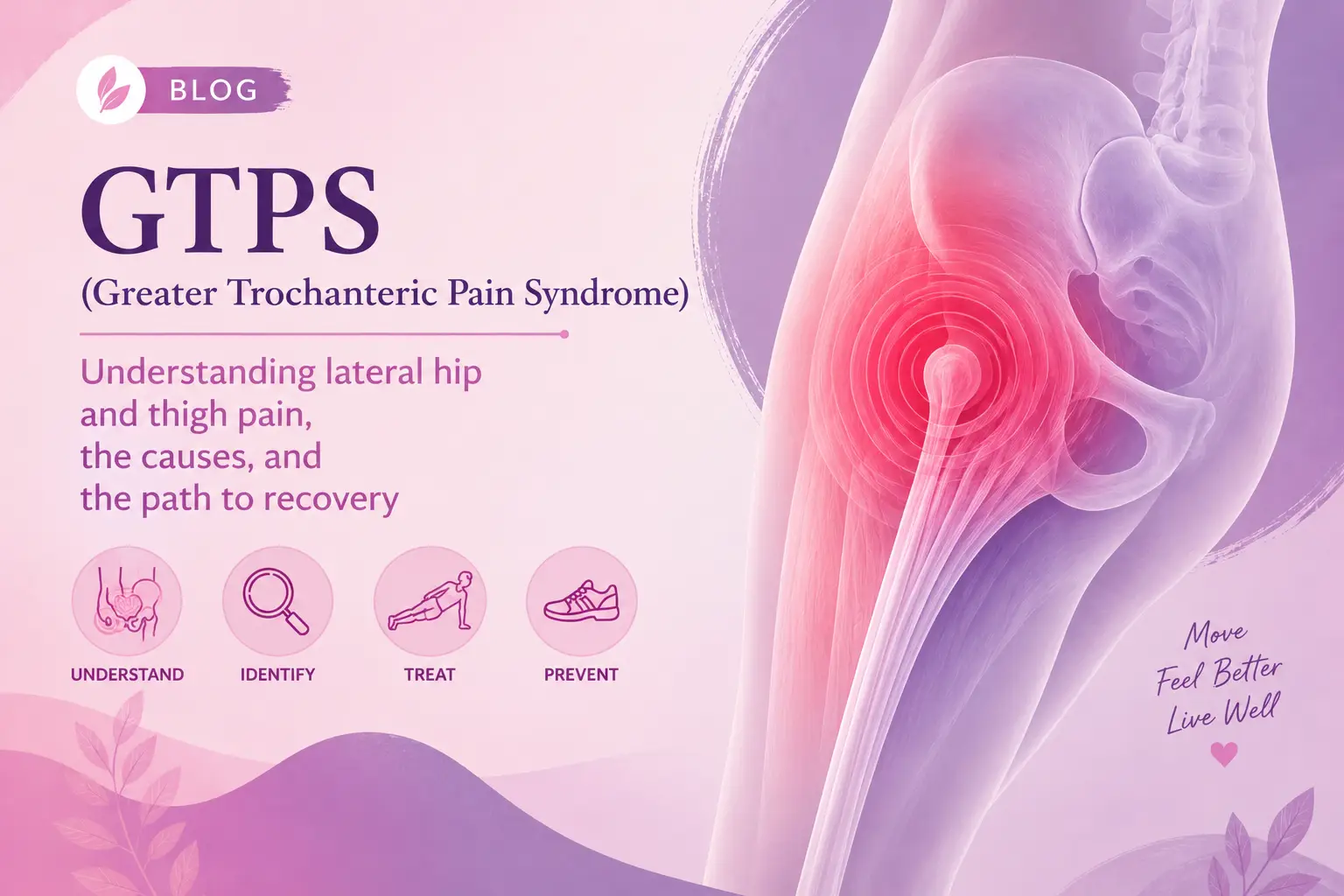
GTPS (AKA Lateral Hip Pain) in menopause: Why It Happens and What Actually Helps
Gluteal tendinopathy (often called Greater Trochanteric Pain Syndrome or lateral hip pain) is one of the most common causes of hip pain I see in women in their 40s and 50s.
Increasingly, there is also a clear pattern in clinic: many of these cases emerge or flare during the menopausal transition. Not necessarily because something has been “damaged,” but because tendon load tolerance, recovery capacity, and tissue sensitivity appear to change during this stage of life.
This is not simply “wear and tear.” It is a load-related tendon condition influenced by both biological and mechanical factors, and it often becomes more noticeable in midlife when the system’s ability to absorb and recover from load is subtly different.
⸻
What does the evidence say?
Gluteal tendinopathy is highly prevalent, particularly in midlife women. It is one of the most common lower limb tendinopathies and is frequently associated with persistent pain and reduced function if not managed appropriately.
Importantly, high-quality systematic reviews consistently show that the most effective management is not passive treatment, but a combination of:
● education about load and compression
● progressive strengthening
● long-term load management strategies
High-quality evidence, including randomised controlled trials and systematic reviews, consistently shows that education + exercise provides superior outcomes compared with injection-only or passive approaches, with meaningful improvements in pain and function across short, medium, and long-term follow-up periods.
⸻
Why is it common in menopause?
There is no single cause, but several interacting factors appear to be relevant, particularly in the women I see in clinic:
- Tendon load tolerance changes
Declining oestrogen may influence:
● collagen turnover
● tendon stiffness regulation
● recovery from mechanical load
This may reduce the “buffer” tendons have against everyday compression and tensile load, meaning normal activities can start to feel disproportionately painful.
⸻ - Compression + load sensitivity
The gluteal tendons are particularly sensitive to compression and combined load positions such as:
● side-lying on the affected hip
● crossing legs
● single-leg loading (walking, stairs, standing on one leg)
During menopause, these previously tolerated positions often become provocative without any clear injury event.
⸻ - Neuromuscular control changes
Midlife is often associated with subtle but important changes such as:
● slight reduction in hip abductor strength and endurance
● altered gait or movement strategies
● reduced efficiency in how load is distributed through the hip
This can increase focal stress over the lateral hip region.
⸻ - Pain system sensitisation
In many women, this is not just a tissue issue. Factors such as:
● sleep disruption
● stress load
● persistent or recurrent pain history
can amplify pain sensitivity and lower the threshold for symptoms during everyday movement.
⸻
Typical symptoms
Women often describe:
● Pain over the outside of the hip
● Pain lying on the affected side at night
● Pain walking, stairs, or standing on one leg
● Pain that can sometimes radiate down the lateral thigh
● Morning stiffness or “start-up pain”
⸻
What actually helps? (Best evidence-based approach) - Education + load modification (first-line)
This is usually the most important starting point.
Key principles include:
● Avoid sustained compression positions (e.g. crossing legs or prolonged side-lying on the painful side)
● Avoid sudden spikes in walking or standing load
● Modify activity rather than stopping it completely
This aligns strongly with current expert consensus and systematic review evidence supporting education + exercise as first-line care.
⸻ - Progressive strengthening (core treatment)
Rehabilitation should focus on rebuilding load capacity through:
● hip abductor strength (glute med/min)
● single-leg control and stability
● gradual, progressive exposure to functional load
Commonly used approaches include:
● early-stage isometric abduction for pain modulation
● carefully dosed side-lying or standing abduction progressions
● step-ups and single-leg control work
● functional strengthening such as walking and stair tolerance
⸻ - Avoid aggravating “stretching”
One of the most common misconceptions is that ITB or glute stretching will help.
In reality, these positions can increase compression over the tendon and may aggravate symptoms in many cases.
⸻ - Reduce but don’t eliminate load
The goal is not rest, but appropriate loading:
● modify rather than avoid activity
● keep the tendon exposed to tolerable load
● build capacity gradually over 3–6+ months
⸻ - Adjuncts (secondary role)
Some options may help symptom management in certain cases:
● shockwave therapy – may reduce pain in chronic cases
● corticosteroid injection – short-term relief but not a long-term solution, and must be provided alongside a thorough shared decision-making process to ensure awareness of risks to tendon health
● PRP – mixed evidence, not first-line
⸻
Key clinical takeaway
Gluteal tendinopathy in menopause is something I see frequently in clinic, and it is best understood as a load + compression + recovery capacity mismatch, rather than a structural failure or inevitable degeneration. - The best treatment? It’s not a new machine or magic wand, but it is cost-effective………The most effective long-term outcomes consistently come from: education + progressive loading + long-term load management!
REFERENCES
🔹 Key clinical trial (first-line management evidence)
Mellor, R., Bennell, K., Grimaldi, A., et al. (2018)
. Education plus exercise versus corticosteroid injection for gluteal tendinopathy: a randomised controlled trial.
BMJ, 361, k1662.
Available at: https://www.bmj.com/content/361/bmj.k1662
⸻
🔹 Systematic review / exercise-based tendon rehab evidence
Morrissey, D., Cotchett, M., Said, J., et al. (2018)
Management of greater trochanteric pain syndrome: a systematic review.
BMJ Open Sport & Exercise Medicine, 4(1), e000344.
Available at: https://bjsm.bmj.com/content/early/2019/05/14/bjsports-2018-099842
⸻
🔹 Clinical mechanism / pathophysiology (load + compression model)
Fearon, A.M., Scarvell, J.M., Cook, J.L., Smith, P.N. (2014)
Greater trochanteric pain syndrome: defining the clinical syndrome.
British Journal of Sports Medicine, 48(21), 1685–1689.
Available at: https://pubmed.ncbi.nlm.nih.gov/24780842/
⸻
🔹 Tendon mechanobiology / load response framework
Cook, J.L. and Purdam, C.R. (2009)
Is tendon pathology a continuum? A pathology model to explain the clinical presentation of load-induced tendinopathy.
British Journal of Sports Medicine, 43(6), 409–416.
⸻
🔹 Contemporary tendon rehab consensus (supporting progressive loading approach)
Rio, E., Kidgell, D., Moseley, G.L., et al. (2015)
Isometric exercise induces analgesia and reduces inhibition in patellar tendinopathy.
British Journal of Sports Medicine, 49(19), 1277–1283.
⸻
🔹 Imaging / structural vs symptom mismatch (useful supporting concept)
Grimaldi, A., Mellor, R., et al. (clinical consensus work across hip tendinopathy literature)
(Used widely in GTPS rehabilitation frameworks; supports load-based model over structural damage model)
⸻
🔹 Hormonal / menopause MSK context (supporting rationale, not GTPS-specific)
Systematic review: musculoskeletal pain in menopause (PMC12784006)
Available at: https://pmc.ncbi.nlm.nih.gov/articles/PMC12784006/