
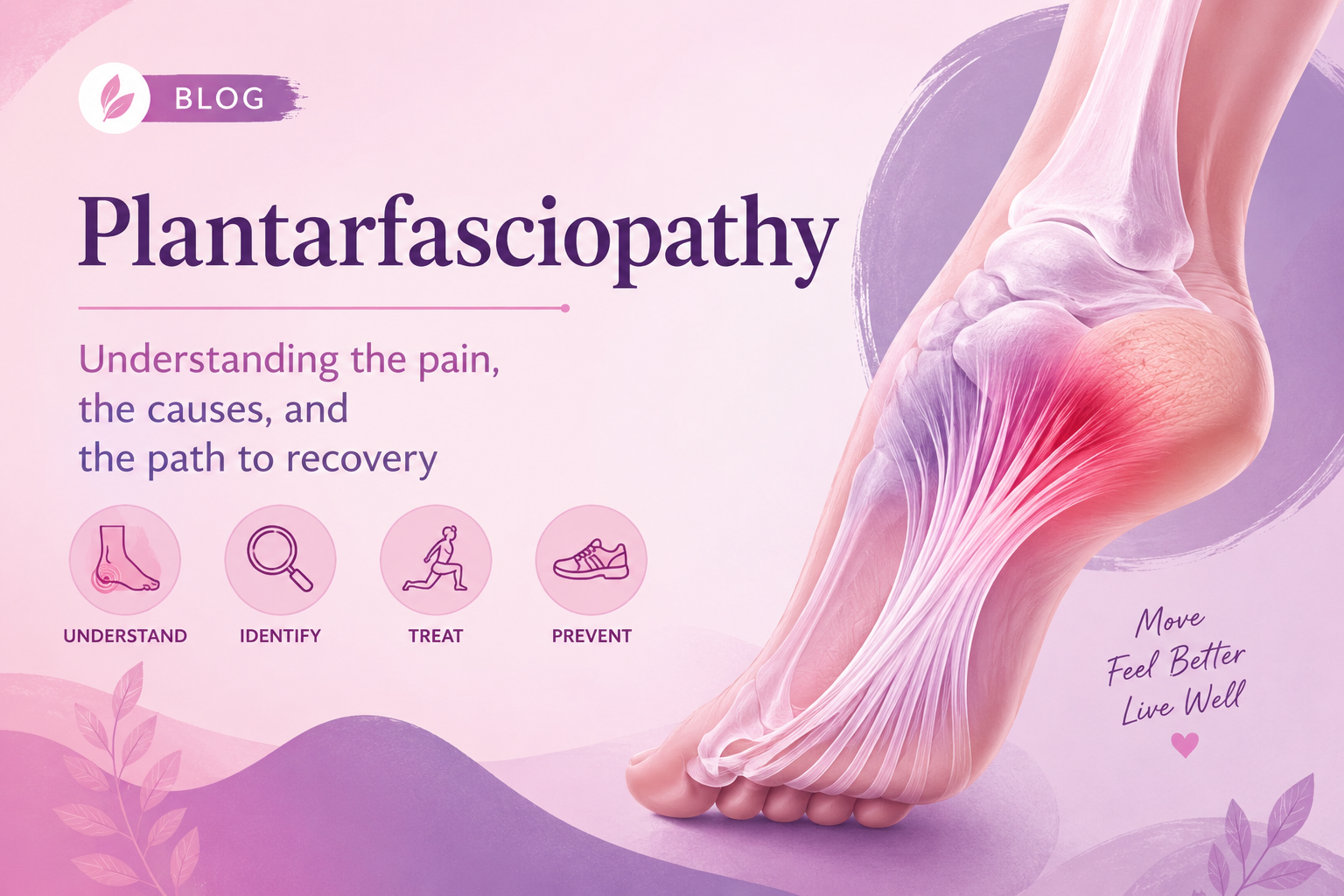
Plantar fasciopathy (often still called plantar fasciitis) is one of the most common causes of heel pain I see in women in their 40s, 50s and beyond.
Very often, women describe a very similar pattern: there has been no clear injury, no major change in activity, and yet suddenly the first steps in the morning, or standing after sitting, have become painful and stiff.
Increasingly, this fits a wider pattern I see across midlife musculoskeletal conditions — symptoms emerging or flaring during the menopausal transition. Not because something is “breaking down,” but because the way tissues respond to load, recover, and tolerate stress can subtly change during this stage of life.
Plantar fasciopathy is therefore not simply an overuse injury. It is a load-related condition of the plantar fascia, influenced by both mechanical stress and biological sensitivity.
⸻
What does the evidence say?
Plantar fasciopathy is now well understood as a degenerative overload condition of the plantar fascia, rather than an inflammatory condition.
Across high-quality studies, the most effective long-term management is consistent:
● progressive loading of the plantar fascia and calf complex
● load management (not complete rest)
● education and self-management strategies
● gradual improvement over time (often 8–12+ weeks minimum, and longer for chronic cases)
Passive treatments alone (such as rest or symptom-only approaches) are rarely effective long term.
The key principle across all current evidence is that the plantar fascia responds best to progressive, well-dosed load exposure over time.
⸻
Why might menopause play a role?
There is no single cause of plantar fasciopathy, but in many women I see in midlife, several factors overlap:
⸻
- Changes in connective tissue resilience
Declining oestrogen may influence connective tissue properties, including:
● collagen turnover
● fascial stiffness regulation
● recovery after repeated daily loading
This may reduce the plantar fascia’s ability to recover between everyday load cycles such as walking and standing.
⸻ - High daily load exposure
Unlike many other tendon conditions, the plantar fascia is loaded constantly through:
● walking
● standing
● step count variability
● footwear changes
Because the load is unavoidable, even small reductions in tolerance can quickly become symptomatic.
⸻ - Calf and foot capacity changes
In midlife, I often see:
● reduced calf strength endurance
● reduced ankle stiffness control
● subtle changes in gait efficiency
This can shift more stress onto the plantar fascia during every step.
⸻ - Pain system sensitivity
As with many musculoskeletal conditions during menopause, symptoms can be influenced by:
● poor sleep
● increased stress load
● previous or persistent pain experiences
This can lower the threshold for pain, meaning the same load feels more symptomatic than it previously did.
⸻
Typical symptoms
Most women describe:
● Sharp heel pain on first steps in the morning
● Pain after sitting then standing (“start-up pain”)
● Pain after prolonged standing or walking
● Tenderness under the inside of the heel
● Symptoms that ease slightly once “warmed up,” then may return later in the day
⸻
What actually helps? (Best evidence-based management)
⸻ - Progressive loading (main treatment)
The strongest evidence supports gradual loading of the plantar fascia and calf complex, not rest.
This usually includes:
● slow, progressive calf raises (both bent and straight knee)
● plantar fascia-specific loading (toe-loaded or short-foot style exercises)
● gradual increase in walking and standing tolerance
The key principle is that the tissue needs load to adapt — but it must be progressively dosed and tolerable.
⸻ - Load management (not avoidance)
In practice, this means:
● reducing sudden spikes in step count
● temporarily limiting barefoot walking on hard surfaces
● pacing long standing periods if needed
● keeping movement consistent rather than stop–start cycles
The aim is not to avoid load, but to match load to current capacity.
⸻ - Footwear (short-term support only)
Supportive footwear can help reduce symptoms in the early stages or flare-ups.
However, the long-term goal is always:
improving tissue capacity so reliance on footwear reduces over time
⸻ - Adjuncts (secondary support)
These may be useful in selected cases:
● taping (short-term symptom relief)
● shockwave therapy (often used in persistent/chronic cases)
● orthoses (short-term load reduction in some individuals)
These should support, not replace, active rehabilitation.
⸻
Key clinical takeaway
Plantar fasciopathy in menopause is something I see regularly in clinic, and it is best understood as a load tolerance mismatch in a tissue exposed to constant daily stress, alongside possible changes in recovery capacity during midlife.
The most reliable long-term improvement comes from:
progressive loading + smart load management + consistency over time
References
 Core plantar fasciopathy evidence (mechanism + management)
Rathleff, M.S., et al. (2014)
High-load strength training improves outcome in patients with plantar fasciitis: a randomized controlled trial.
Scandinavian Journal of Medicine & Science in Sports, 25(3), e292–e300.
https://pubmed.ncbi.nlm.nih.gov/25040538/
⸻ Clinical review / diagnosis & management
Riddle, D.L., et al. (2003)
Etiology and treatment of plantar fasciitis.
The Journal of Bone and Joint Surgery, 85(5), 872–882.
https://pubmed.ncbi.nlm.nih.gov/12728024/
⸻ Systematic review (exercise & conservative treatment effectiveness)
Thomson, C.E., et al. (2015)
Plantar heel pain: a systematic review of conservative treatment.
Journal of Foot and Ankle Research, 8, 16.
https://jfootankleres.biomedcentral.com/articles/10.1186/s13047-015-0071-3
⸻ Shockwave therapy evidence
Gerdesmeyer, L., et al. (2008)
Radial extracorporeal shock wave therapy is more effective than placebo for chronic plantar fasciitis.
The American Journal of Sports Medicine, 36(11), 2100–2109.
https://pubmed.ncbi.nlm.nih.gov/18838740/
⸻ Tendon/plantar fascia load-response model (mechanism framework)
Cook, J.L. & Purdam, C.R. (2009)
Is tendon pathology a continuum? A pathology model to explain the clinical presentation of load-induced tendinopathy.
British Journal of Sports Medicine, 43(6), 409–416.
https://bjsm.bmj.com/content/43/6/409
⸻ Menopause + MSK context (supporting biological plausibility)
Schaap, L.A., et al. (2015)
Musculoskeletal pain during menopause: a systematic review.
Maturitas, 81(3), 376–386.
https://pubmed.ncbi.nlm.nih.gov/25882574/